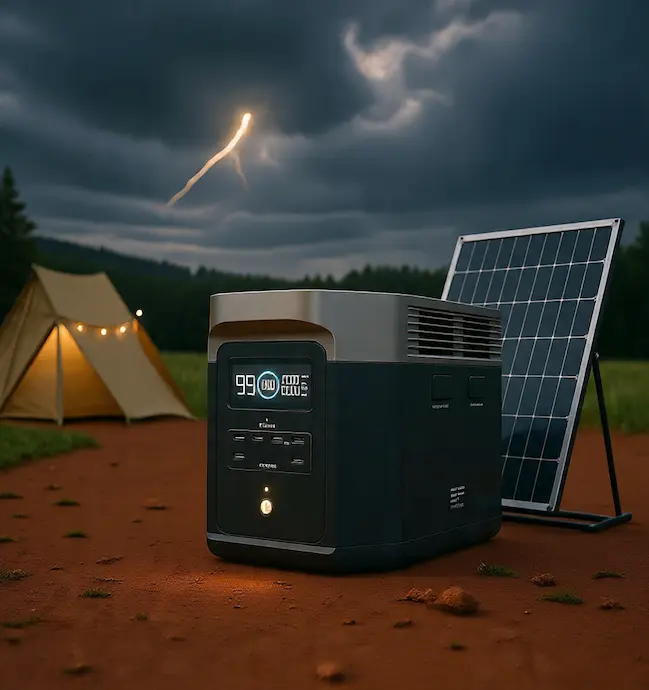
Best Portable Power Stations Australia 2026 — For Camping, Blackouts & When the Grid Lets You Down
The grid isn’t as reliable as you think. Here’s what to do about it.
You’ve probably never thought twice about plugging something in. You flick the switch, the lights come on, the fridge hums along, and life continues. That’s how it’s supposed to work.
Until it doesn’t.
A wild storm rolls through overnight. A cyclone batters the coast. Floodwaters take out a substation. And just like that — no warning, no timeline — the power is gone. The fridge starts warming. The kids are asking why the lights won’t turn on. Your phone is at 12%. And you’re wondering how long this is going to last.
For millions of Australians every year, that moment isn’t hypothetical.It’s Tuesday night after a summer storm. A week after a flood event in regional Queensland. Three days into a cyclone recovery in the north. Grid power fails — and when it does, it often fails for days, not hours.
A portable power station changes that equation entirely. Whether you’re deep in the bush on a family camping trip or sitting at home watching the weather radar light up red, having your own power source means the fridge stays cold, the lights stay on, and you stay in control.
The Grid Is More Fragile Than You Think
Australia’s electricity network covers some of the most challenging geography on earth. Long transmission lines, extreme heat, fierce storms, and ageing infrastructure all combine to make outages not just possible — but predictable.
The Australian Energy Market Operator has consistently reported that weather events are the single biggest driver of unplanned outages. Cyclones in Queensland and WA, severe thunderstorms in Victoria and NSW, floods across the east coast — these aren’t rare disasters anymore. They’re a recurring part of Australian life.
And it’s not just catastrophic events. A single lightning strike near a substation can take out power to thousands of homes. A heatwave can trigger rolling brownouts. A fallen tree can cut the line to your street for 48 hours while crews work through a backlog of callouts.
The pain isn’t just inconvenience.It’s a fridge full of food going to waste. Medication that needs refrigeration. Kids who can’t sleep without a fan in 35-degree heat. That feeling of powerlessness — no pun intended — of having no options
One Tool. Two Completely Different Problems.
Here’s what makes a quality portable power station such a smart investment: it solves two separate problems with the same piece of gear.
Problem 1: You’re going camping. Whether it’s a long weekend at a caravan park, a week-long 4WD trip through Gippsland, or a family camp-out under the stars, you want power without dragging a noisy, smelly generator into the campsite. A portable power station runs silently, charges from solar panels during the day, and keeps your camp fridge cold, your lights glowing, and your devices charged all night.
Problem 2: The grid goes down. Storms, floods, cyclones — whatever the cause, when the power goes out at home, your portable power station becomes your household backup. Plug in the fridge. Keep the lights on. Charge the phones. Keep the family comfortable while you wait it out.
One purchase. Two completely different scenarios. Both solved.
That’s the relief that comes with owning one of these — and once you’ve had that peace of mind, going without it feels unthinkable.
Our Top Picks for 2026
We’ve focused this guide on the mid-range sweet spot — units with 1000–2000Wh of capacity that are genuinely portable, solar-compatible, and capable enough to run a camp fridge or household essentials during an outage. These are the units that hit the balance of power, portability, and price that make the most sense for the majority of Australians.
All picks are available through Amazon Australia with fast delivery.
🏆 Best Overall — EcoFlow Delta 2
Capacity: 1024Wh | Output: 1800W AC | Battery: LiFePO4 | Solar Input: Up to 500W | Charge Time (AC): ~1.2 hours
The EcoFlow Delta 2 is consistently the recommendation that makes the most sense for the widest range of buyers — and for good reason. It’s powerful enough to run a full-size fridge, fast enough to charge from empty to full in just over an hour via wall power, and smart enough to switch to battery automatically when the grid drops (Emergency Power Supply mode activates in under 30ms — fast enough that most devices won’t even notice).
The 1800W output is genuinely useful. That means you can run a microwave, power tools, a portable induction cooker, or multiple devices simultaneously without the unit breaking a sweat. Six AC outlets, four USB-A ports, and two 100W USB-C ports mean the whole family can charge at once.
Solar charging up to 500W means paired with a 200W solar panel, you can keep this unit topped up indefinitely — critical for multi-day camping or extended outages. The LiFePO4 battery is rated to 3000 cycles (that’s roughly 8+ years of regular use), and it handles Aussie heat far better than standard lithium-ion chemistry.
This is the unit we’d recommend to someone who wants to tick both boxes — camping use and home emergency backup — with a single purchase.
👉 Check the EcoFlow Delta 2 on Amazon Australia (affiliate link)
🥈 Best for Power & Longevity — Jackery Explorer 2000 Plus
Capacity: 2042Wh | Output: 3000W AC (6000W surge) | Battery: LiFePO4 | Solar Input: Up to 1400W | Charge Time (AC): ~2 hours | Battery Cycles: 4000+
If you want serious power that will still be performing a decade from now, the Jackery Explorer 2000 Plus is the one. It’s a bigger, more capable unit than the Delta 2 — and for buyers who want to solve both the camping problem and the home resilience problem with a single purchase, it’s arguably the better long-term investment.
The 3000W continuous output (with a 6000W surge) means this unit handles genuinely demanding loads — full-size fridges, microwaves, power tools, air conditioning units, CPAP machines, and multiple devices running simultaneously. It won’t blink at anything a typical Australian household needs during an outage.
The 4000-cycle LiFePO4 battery is the other standout. At one cycle per day, that’s over 10 years before the battery drops below 70% capacity — backed by Jackery’s 5-year warranty. Quiet Charging Mode keeps noise at 30dB (library-quiet), which matters if you’re using this at the campsite or running it overnight at home.
Solar input up to 1400W is exceptional — connect up to six 200W Jackery solar panels and you’re back to full charge in around two hours of good sunlight. And if your needs grow, the unit is expandable up to 24kWh with additional battery packs — making it a genuine long-term home energy system, not just a portable station.
The EPS switchover activates in 20ms, fast enough that fridges, routers, and most appliances won’t even notice the grid has dropped.
👉 Check the Jackery Explorer 2000 Plus on Amazon Australia (affiliate link)
🥉 Best for Extended Outages — EcoFlow Delta 2 Max
Capacity: 2048Wh | Output: 2400W AC | Battery: LiFePO4 | Solar Input: Up to 1000W | Expandable: Yes, up to 6kWh
If you live in a storm-prone region, run medical equipment at home (CPAP, nebulisers), or want genuine multi-day resilience without relying on solar recharging, step up to the Delta 2 Max. Double the capacity of the standard Delta 2 means you can run a typical household fridge for close to 48 hours without solar input — and with a 200W panel on the roof or in the yard, you’re potentially indefinite.
The 2400W output opens up more appliances, and the expandable battery system means you can add capacity down the track if your needs grow. At roughly 23kg it’s still moveable — this won’t slip into a backpack, but it’ll sit on a trolley or in the back of a 4WD without issue.
👉 Check the EcoFlow Delta 2 Max on Amazon Australia (affiliate link)
Don’t Forget the Solar Panel
A portable power station without a solar panel is a big battery — useful, but finite. Add a solar panel and it becomes an indefinite power source.
For most buyers, a 200W foldable solar panel is the practical sweet spot. It’s manageable to carry, sets up in minutes, and in typical Australian sunshine conditions will put meaningful charge back into a 1000Wh unit throughout the day.
Both EcoFlow and Jackery make excellent folding panels designed to pair with their respective units, but most units accept panels from any brand via a standard MC4 connection. Look for MPPT charging controllers — they maximise the energy drawn from panels by 20–30% compared to cheaper alternatives, which matters especially in partial shade or high-heat conditions.
👉 Browse compatible solar panels on Amazon Australia (affiliate link)
What to Look For When Buying
Capacity (Wh — Watt hours): This is how much total energy the unit stores. A 45W camp fridge running 24 hours uses roughly 1080Wh. A 1000Wh unit will get you close to a full day; a 2000Wh unit gives you comfortable margin.
Output (W — Watts): This determines what you can run simultaneously. 1500W handles most camping and home essentials. 1800W+ opens up microwave and small appliances.
Battery Chemistry: Look for LiFePO4 (also written as LFP). It’s safer, more stable in heat, and lasts far longer than standard lithium-ion. Non-negotiable for Australian conditions.
Solar Input: More is better. 500W solar input means faster recharging during the day. Look for MPPT controller compatibility.
UPS / EPS Mode: This is the automatic switchover function — the unit detects grid power loss and switches to battery power automatically. Essential if you’re using this as home backup.
Planning your full camp setup ? See our guide to the best camping mattresses for Australia.
The Bottom Line
Grid power will fail again. In Australia, it’s a matter of when, not if. Whether it’s the next big storm to roll through, a flood event that takes out local infrastructure, or a cyclone season that reminds coastal communities just how exposed the network can be — the question isn’t whether you’ll face an outage. It’s whether you’ll be ready for it.
A portable power station doesn’t just solve the camping problem. It solves the family resilience problem.It’s the fridge that stays cold when everything around you goes dark. The lights that come on when the kids get scared. And the phone that stays charged so you can contact emergency services, check on family, or simply stay informed.
And on the weekend camping trip — when you’re parked up in the bush, solar panel angled to catch the afternoon sun, camp fridge running cold, lights strung up between the gums — it’s just the quiet satisfaction of knowing you’ve got everything you need, completely off-grid, completely self-contained.
That’s what a good power system gives you. Not just watts and amp-hours. Peace of mind.
Quick Comparison
| Model | Capacity | Output | Battery Cycles | Best For | Buy |
|---|---|---|---|---|---|
| EcoFlow Delta 2 | 1024Wh | 1800W AC | 3000 cycles (~8 yrs) | Best all-rounder — camping & home backup | Check Price on Amazon AU |
| Jackery Explorer 2000 Plus | 2042Wh | 3000W AC | 4000+ cycles (~10 yrs) | Best power & longevity — heavy loads & extended use | Check Price on Amazon AU |
| EcoFlow Delta 2 Max | 2048Wh | 2400W AC | 3000 cycles (~8 yrs) | Best for extended outages — multi-day resilience | Check Price on Amazon AU |
All products linked above are available through Amazon Australia. As an Amazon Associate, Camp With Nature earns from qualifying purchases — at no extra cost to you. We only recommend gear we’d use ourselves.