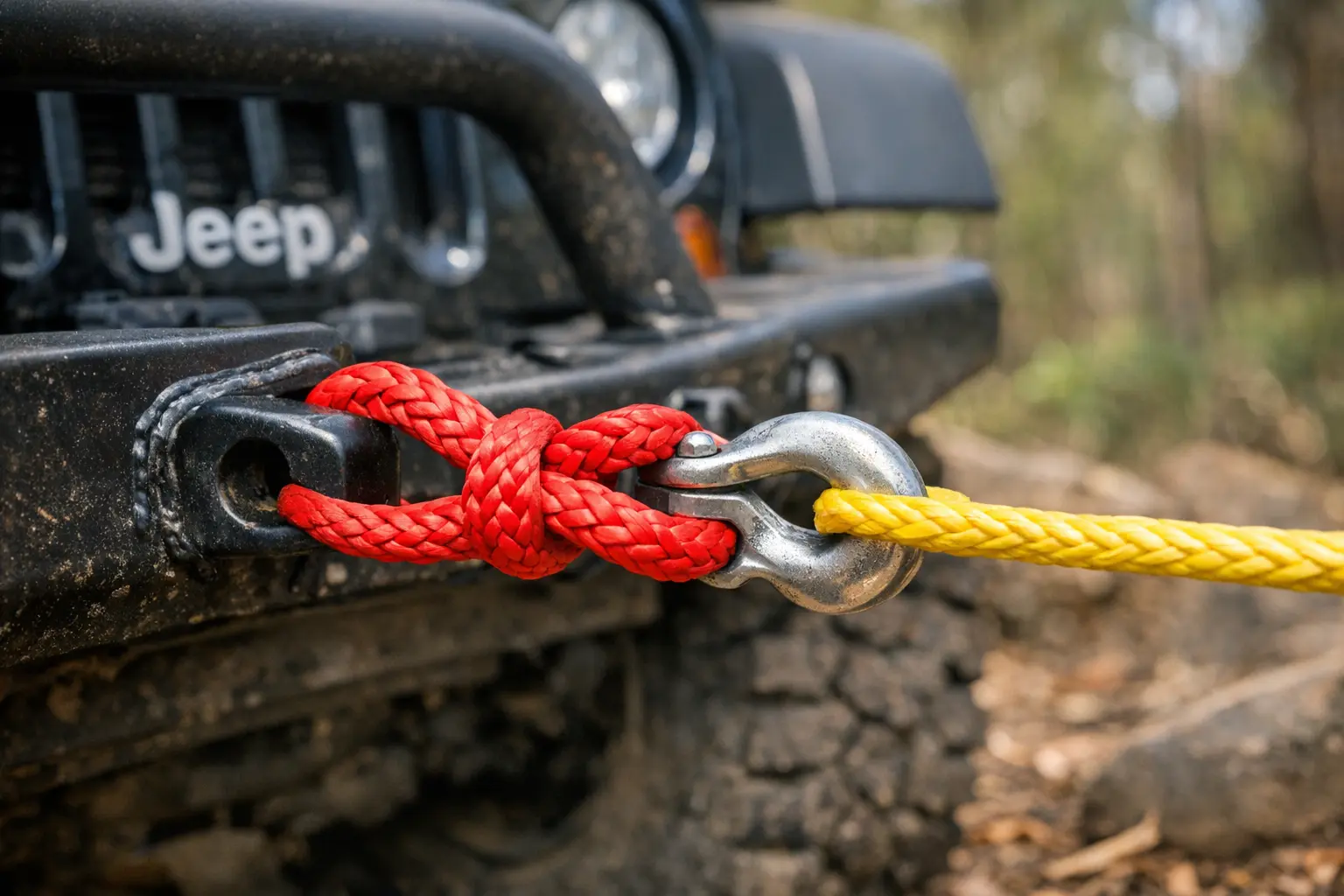
Soft Shackles for 4×4 Recovery: Types, Sizes & Our Top Picks
If you’ve spent any time around serious 4WDers lately, you’ve probably noticed the old steel D-shackle slowly getting replaced by something that looks more like a knot than a piece of hardware. That’s a soft shackle — and once you understand what they do, it’s hard to go back.
Whether you’re winching yourself out of a bog up in the high country or helping a mate on a river crossing through Gippsland, soft shackles are one of those upgrades that just make sense. Let’s break them down.
What Is a Soft Shackle?
A soft shackle is a connector made from high-strength synthetic rope — typically UHMWPE (Ultra-High Molecular Weight Polyethylene), better known under brand names like Dyneema or Spectra — formed into a loop with a stopper knot at one end. It does the same job as a traditional steel D-shackle: connecting recovery straps, winch lines, tree saver straps, and snatch blocks. But it does it lighter, safer, and in many cases, even stronger.
Think of it as the smarter evolution of recovery hardware. No pins to drop in the dirt, no rust, and no heavy chunk of steel flying at your windscreen if something lets go under load.
Why Switch From Steel?
Steel shackles have worked for decades and there’s nothing wrong with a quality rated D-ring. But they have real drawbacks:
- Heavy and bulky to carry
- Can rust, seize up, and become difficult to undo after a hard recovery
- If a strap or shackle snaps under load, steel becomes a dangerous projectile — it can punch right through a vehicle or cause serious injury
Soft shackles flip most of those problems:
- Up to 80% lighter than a comparable steel shackle
- Float on water — great for river crossings
- Won’t rust or corrode
- Easy to undo even after a hard pull — they don’t over-tighten under load
- If they do fail, they simply drop to the ground rather than becoming a projectile
- Flexible enough to wrap around recovery points where a steel shackle might bind or won’t fit
The one area where steel still wins? High heat. UHMWPE fibres have a relatively low melting point (around 145°C), so keep soft shackles well clear of exhaust pipes and anything hot under the bonnet.
What Are They Made From?
The material matters. Here’s what you’ll see on the labels:
Dyneema (SK75 / SK78) The gold standard for 4×4 soft shackles. Dyneema is a brand name for UHMWPE fibre — it doesn’t absorb water, holds its strength wet or dry, and is genuinely stronger than steel by weight. SK75 and SK78 are the two grades most commonly used in recovery shackles, with SK78 offering slightly better resistance to creep (stretch) under sustained load. Most quality 4WD shackles are 12-strand Dyneema construction.
Spectra Very similar to Dyneema in performance — low stretch, floats on water, and handles wet conditions well. Often used interchangeably with Dyneema in product descriptions.
HMPE (High Modulus Polyethylene) The same fibre family as Dyneema and Spectra — just a more generic label. If a shackle is listed as UHMWPE or HMPE and is clearly rated, it’s the same core material.
Technora / Proprietary Blends Some brands use fibre blends that combine high tensile strength with improved abrasion resistance. Worth considering if you’re doing a lot of rocky terrain recoveries where shackles take a beating on rough edges.
Types of Soft Shackles
Not all soft shackles are the same design. Here are the main types you’ll come across:
1. Diamond Knot Soft Shackle
The most common type — a loop of Dyneema rope secured with a diamond knot stopper. Simple, proven, and easy to use. This is the standard design used by most brands, including the George4x4 range. Good for everyday winching and strap connections.
2. Button Knot Soft Shackle
A variation that uses a button-style knot instead of a diamond knot. The rounder profile can be slightly easier to grip and push through the eye when opening after a hard pull. George4x4 offers a 9mm button knot version rated to 14,000kg.
3. Black Eye Soft Shackle
A design developed by George4x4, the Black Eye features a small sleeve at the eyelet end that reinforces the loop where it takes the most wear. Named for the distinctive dark collar, it adds durability to the highest-stress part of the shackle without adding much weight.
4. Sleeved Soft Shackle
Any of the above styles with an added protective sheath over the body of the shackle. The sleeve dramatically improves abrasion resistance and extends shackle life — especially important if you’re running them around rough steel recovery points or rocky terrain. Most quality shackles now come with at least a partial sleeve as standard.
5. Fuse Shackles
A more specialised category designed to be the intentional weak link in a recovery system. They’re engineered to fail before more expensive or dangerous components do. Not an everyday item but worth knowing about for more complex recovery setups.
Sizes and Load Ratings
This is the most important part to get right. Soft shackles are rated by their Minimum Breaking Strength (MBS) — the load at which the shackle is designed to fail. Always match your shackle rating to your vehicle and recovery gear.
| Vehicle Type | Recommended MBS |
|---|---|
| Small SUV / Light 4WD | 8,000–12,000kg |
| Standard 4WD (LandCruiser 70, Patrol, Hilux) | 13,000–17,000kg |
| Heavy 4WD / Loaded Dual Cab | 17,000kg+ |
Common sizes and what they suit:
- 9mm / 10mm — Lighter duty applications, smaller vehicles, or secondary connections
- 11mm — The sweet spot for most Australian 4WDs; typically 13,000–16,000kg MBS
- 12mm+ — Heavy duty, for serious winching setups or heavily loaded vehicles
MBS vs WLL: MBS is the breaking point. Working Load Limit (WLL) — the load you should actually use the shackle for — is typically around 20–25% of MBS. A shackle rated 15,000kg MBS has a practical working load of around 3,000–3,750kg. Size your shackle accordingly.
What to Look For When Buying
Before grabbing the cheapest option, here’s what actually matters:
- Clearly rated — Any shackle used for recovery should have its MBS marked. No rating, don’t use it.
- Tested — Look for shackles tested by an accredited lab. Australian-made brands like George4x4 are NATA-accredited lab tested, which means the rating is independently verified.
- Protective sleeve — Abrasion is the main killer of soft shackles. A sleeve significantly extends service life.
- UV resistance — UHMWPE loses strength with prolonged UV exposure. Look for UV-resistant construction and store shackles out of direct sun when not in use.
- Inspect before every use — Check for fraying, cuts, stiff spots, or discolouration. If in doubt, replace it. A $30 shackle is cheap insurance on the tracks.
Our Recommendations on Amazon AU
Here are three solid options you can find and buy right now on Amazon AU.
🥇 Best Overall — George4x4 Black Eye Soft Shackle (11mm / 15,000kg MBS)
This is the standout pick. George4x4 is an Australian brand that hand-splices all their shackles in Brisbane. The 11mm Black Eye design is rated to 15,000kg MBS with a tested breaking strain of over 16,700kg — independently verified by a NATA-accredited lab, not just a sticker on the packet.
The Black Eye sleeve reinforces the eyelet where the shackle sees the most wear, UV-resistant construction, and they float in water. They come in a 2-pack which is exactly what you want — one for front, one for rear. High-vis orange colour means you won’t lose them in the mud.
For most standard Australian 4WDs — LandCruiser 70 Series, Patrol, Hilux — this is the one to buy.
Search on Amazon AU: “George4x4 Black Eye soft shackle 15000kg” Direct link: amazon.com.au — search B0B1PHFY5Y
🥈 Best for Heavy Rigs — George4x4 11mm 18,000kg Soft Shackle (2-Pack)
If you’re running a heavier setup — a loaded dual cab, a GVM-upgraded LandCruiser, or you just want extra headroom in your recovery gear — George4x4 also offers an 11mm shackle rated to 18,000kg MBS. Same Australian-made quality, same Black Eye design, just a bigger rating for peace of mind.
At 65cm open length it also gives you a bit more reach when connecting to awkward recovery points.
Search on Amazon AU: “George4x4 soft shackle 18000kg 65cm” Direct link: amazon.com.au — search B09BNDBPSY
🥉 Budget Backup — KONPWAY Sleeved Soft Shackle (7/16″ / ~15,900kg MBS, 2-Pack)
If you want a spare set to keep in the glovebox or as backup recovery gear, the KONPWAY sleeved soft shackle is a decent option at a lower price point. It’s UHMWPE construction with a protective sleeve, rated to around 35,000lb (~15,900kg) MBS, and ships from within Australia.
It’s not Australian-made, and independent lab testing isn’t specified, so we’d treat it as a secondary rather than a primary recovery shackle. But for the price, it’s a solid backup.
Search on Amazon AU: “KONPWAY soft shackle 7/16”
How to Use a Soft Shackle
Dead simple once you’ve done it once:
- Open the loop by pushing the stopper knot through the eye
- Thread the loop around your recovery point, strap eye, or snatch block
- Pass the stopper knot back through the loop to close it
- Give it a firm tug to confirm it’s seated — the knot locks under load automatically
To release after a recovery: push the knot back through the eye (it’ll be tight — that’s normal and a good sign). Twist the knot 90 degrees as you push to break the friction quicker.
Care and Maintenance
Low maintenance but not zero maintenance:
- Rinse with fresh water after muddy or salt water use
- Air dry away from direct sunlight — UV degrades UHMWPE over time
- Store loosely in a bag or recovery kit pouch, not crushed under heavy gear
- Inspect before every trip — look for cuts, fraying, or stiff/discoloured sections
- Replace if in doubt — they’re affordable enough that you shouldn’t gamble on a worn shackle
Final Thoughts
Soft shackles aren’t a gimmick — they’re a genuine safety upgrade that every 4WD recovery kit should have. Lighter, safer on impact, rust-proof, and often stronger than the steel shackles they replace, they’ve become standard gear for good reason.
Carry at least two — one for your front recovery point, one for the rear. The George4x4 2-packs on Amazon AU make that easy and affordable, and you’re getting Australian-made gear that’s been properly tested.
Got questions about building out a complete 4×4 recovery kit? Check out our other guides on snatch straps, kinetic recovery ropes, and recovery boards.
Have You Used a Soft Shackle?
“We’d love to hear from you! If you’ve made the switch from steel to a soft shackle — or if you’re still on the fence — drop a comment below and let us know your experience.
Which brand are you running? Did it hold up when you needed it most? Any tips for other 4WDers just getting started with recovery gear?
Your feedback helps us keep our guides accurate and helps the wider 4×4 community make better buying decisions. Every comment counts — even if it’s just to say what’s in your kit right now. 👇”
Disclosure: This post contains affiliate links. If you purchase through our links, we may earn a small commission at no extra cost to you. We only recommend products we believe are genuinely worth your money.